Posts

Showing posts with the label Biogeography

The happy plant that escaped to Africa

Image
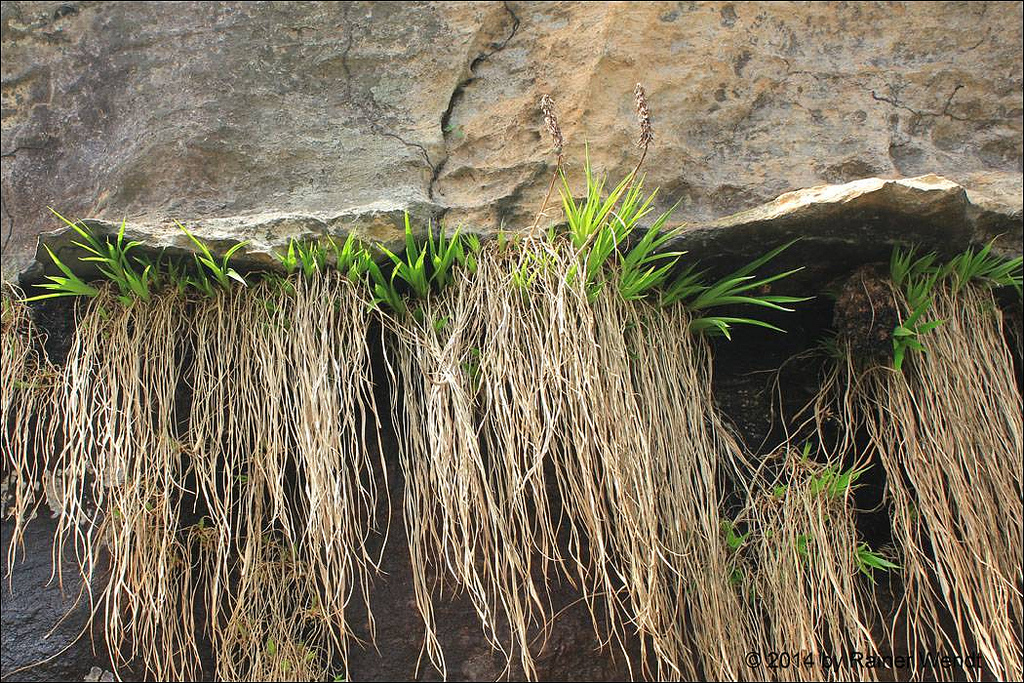
Nestled on the west coast of Africa, a plant lives 3000 km from its 3000 relatives. Most bromeliads are relatively similar in shape but take on a wide variety of habitats in the neotropics. Except one. Meet  Pitcairnia feliciana.

Why is the world's richest biodiversity hotspot so biodiverse? Part 1

Image
Today, 22nd of May, is the International Day for Biodiversity. This time last year, I was living in one of the most biologically rich places of the planet, somewhere on the eastern edge of Ecuador's share of the Tropical Andes biodiversity hotspot ( figure 1 ). As the name suggests, this hotspot englobes the tropical portion of the Andes mountain range, along with its immediate foothills as they spill out into the Amazon rainforest. Figure 1 - Tropical Andes hotspot shaded in dark grey. © X O'Reilly According to some criteria, the Tropical Andes hotspot ranks as the most biodiverse of the biodiversity hotspots. As far as science has thus far revealed, this area holds around 45,000 plant species, nearly half of which are endemic – that is, not native anywhere else. This is both the greatest number of absolute plant species and endemic plant species found in any one biodiversity hotspot. The Tropical Andes also boast more species of terrestrial vertebrate animals than an...
Warm pockets during cold times and a rediscovered species

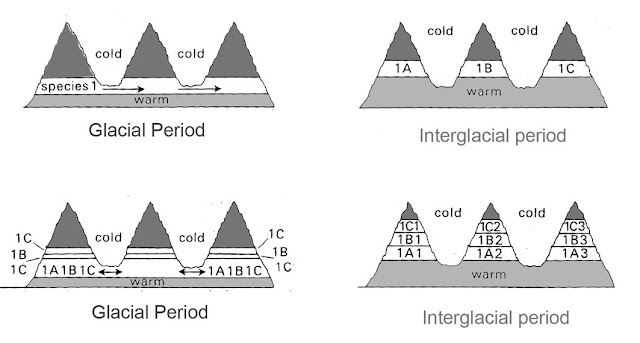
For the last 6 million years or so, the Earth has been subjected to drastic temperature fluctuations. During the Pliocene, the Earth underwent cycles of warm wet and cooler dry periods. Substantial continental ice began to form in the Northern Hemisphere around 3 million years ago (Mya), before the planet was plunged into a series of ice ages. Although you may think of an "ice age" as a snowy period after which woolly mammoths and neanderthals disappeared, you may not know that currently we are simply enjoying a "summer" break from this ice age. The last 2 millions years of Earth's history has consisted of various glacial periods interspersed by warmer times, known as interglacial periods.

When animal and plant populations move up and out

Image
Plants are not always as static as they seem. While most individual plants stay relatively still compared to most animals (no, not all), plant populations can shift laterally over time in an analogous way to animal populations. The main difference is the rooted nature of plants means that they move slowly, across generations. The cause of this is usually environmental: the species is shifting as the climate changes or as competition or another form of pressure encroaches it. Richard Brusca and colleagues have published the results of a plant survey in Arizona which shows that species distributions have changed in the last 50 years. Since a survey carried out by Robert Whittaker in 1963, the vegetation on an area of the Catalina Mountains has crept its way higher up the mountain. Given the difference requirements and tolerance range of different plant species, the entire vegetation does not shift simultaneously or equally; this means that community composition has changed as some plan...

Is the Amazon still hurting over old extinctions?

Image
Mineral nutrients are essential components of any ecosystem. Their absolute presence and relative representation in an environment help shape habitats and the communities that can be supported on them. These nutrients can be one of the most important limiting factors to an ecosystem's productivity. The Amazon rainforest is one of the biologically richest environments on Earth. However, its soil is relatively poor, and much of the vegetation it supports lives on other plants (e.g. see previous posts  Who's who up a tree and Kingdom in the canopy ). One important limited nutrient in the Amazon Basin as a whole is phosphorous. Phosphorous (hereafter represented by its chemical symbol, P) is important for all living cells, with an active roll in energy transport and obtention in the form of ATP; as a core component of our DNA in the form of inorganic phosphate; and composing the living cell walls as phospholipids. Plants have the ability to take inorganic P from the soil and inc...

Happy World Tapir Day!

Image
Image 1.1 - Tapir-themed jungle cake The 27th of July is world tapir day. Last year I became aware of this event through a tapir-obsessed friend of mine, Michael Natt (who's birthday it also happens to be – hippy barfday !). Now that I am living in a place tapirs are native to, I thought it would be appropriate to celebrate this day here at the Timburi Cocha research station with a tapir-themed jungle cake ( Image 1.1 ) and to dedicate these bizarre mammals a blogpost. Image 1.2 - Quick world tapir card to celebrate the occasion. © X O'Reilly

Madagascar's Lucky Break and Endemic Invaders

Image
Evolutionary consequences of Madagascar's isolation on extinct and extant vertebrate fauna © O'Reilly, X. (2010) Madagascar lies off the heal of the African continent. The world’s fourth largest island, on the map it is dwarfed by Africa’s shadow – but only in size.  Famous for the immense variety of weird and wonderful organisms it is home to, most of which are found nowhere else, Madagascar’s unique biological catalogue is the result of millions of years of evolution in isolation, as well as its dramatically varied relief. Its most famous inhabitants, by far, are the lemurs – a whole group of endemic primates that come in a variety of forms, each uniquely adapted to specific niches throughout island’s amazing range of habitats.   But lemurs are thought to have arrived on the island after its split from Africa – what was living on Madagascar at the time of its birth? What proportion of its current terrestrial vertebrate fauna actually split away with the is...