Posts

Showing posts with the label Biotic interactions

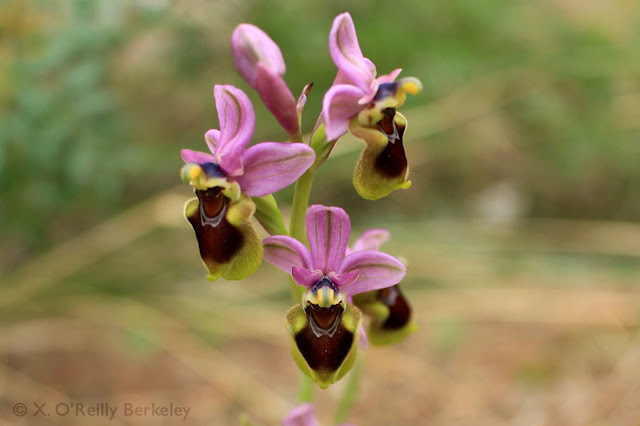
Bee orchids

Image
Sawfly orchid ( Ophrys tenthredinifera )

Water Worlds

Image
This post was originally published under the title  "Water Worlds"  in the December 2016 issue of  The Biologist , the Royal Society of Biology's magazine. If you're a member of the RSB you can also view the  article on their website here . Tropical rainforests are known for being full of life. Whether you're captivated by the calls of colourful birds, mesmerised by hypnotically patterned cats, or fascinated by the apparently infinite variety of invertebrate life, you still have to acknowledge that what makes a rainforest are the plants. A forest is by definition a collection of trees, but there is a whole lot more to plant life in a rainforest. Coating every surface, including the trees themselves, are more plants. Some of these we would as surface-covering vegetation in temperate environments as well, like the mosses and liverworts that coat stone walls or the dandelions that poke their sunny faces out between cracks in the concrete. However, there are ...

Seagrass ecosystem services (Grass Roots Biology)

Image
This post was originally published under the title "Grass Roots Biology" in the December 2015 issue of  The Biologist , the Royal Society of Biology's magazine. If you're a member of the RSB you can also view the article on their website here . The images are not those used by the RSB nor are they mine, the copyright belongs to their credited owners and most are from ARKive.org. Neptune grass ( Posidonia oceanica ) meadow in the Mediterranean © M. San Felix, from  l ivescience.com Grass Roots Biology Home to myriad species and acting as massive carbon sinks, seagrass meadows are key marine habitats – but they are disappearing fast, reports Xaali O'Reilly Berkeley The Biologist  62(6) p16-19 Seagrasses are a group of flowering plants adapted to live in salt water. They grow, flower and pollinate completely submerged in estuaries and along shallow coastal waters around the globe, both in temperate and tropical environments. Although they physi...

Evolution, in real-time

Image
Plant-insect interactions constitute fundamental component communities of terrestrial ecosystems [1] [2] . The different types of plant-insect associations in nature are thought to have driven both plant and insect radiation [3] . The advantages of animal-mediated pollination have led to the evolution and diversification of specialist mutualisms between, for instance, plants and birds (e.g. [4] ), while the need for protection has spawned mutualisms between various tropical tree species and ants [5] [6] [7] . Herbivory, on the other hand, has led to an arm’s race of plant defence mechanisms and insect attack and feeding habits [3] . An ever-increasing number of studies demonstrate the importance of biotic interactions in driving evolutionary change, but considerably fewer reveal the mechanisms by which this occurs in real-time [8] [9] . Monarch caterpillar ( Danaus plexippus ) on milkweed ( Asclepias syriaca ). Credit: Kailen Mooney

Pollinators get a buzz off caffeine, too

Image
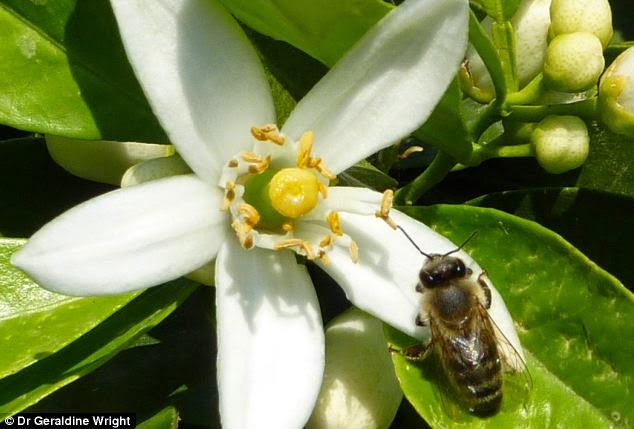
Most plants can reproduce asexually – that is, new plant life is created without the need for female and male sex cells to combine. However, amongst plants there is a variety of ways in which they can reproduce sexually. Sexual reproduction confers certain advantages to organisms: for example, by the remixing of sexual cells, more variation is maintained within a population and there are more likely to be some organisms able to withstand environmental changes. Animal-mediated pollination is a common way by which plants distribute their sex cells to other individuals in a population. Plant have evolved a wide variety of mechanisms to increase the likelihood of pollination, including conspicuous flowers, enticing scents, and sweet nectar rewards. Coffea and Citrus are plant genera which both exhibit attractive flowers and produce more fruit and seeds when pollinated by bees (Ricketts, 2004), which they reward with nectar. However, the nectar of species in these genera contain anoth...

A gene that protects malarial parasites from mosquito defences

Despite a relatively low mortality rate, there are hundreds of millions of malaria cases worldwide per year, making the parasitic disease responsible for a massive annual death toll [1,2] . The definitive hosts of the apicomplexan parasites that cause malaria ( Plasmodium spp ) are anopheline mosquitoes, and various attempts have been made in endemic areas to control mosquito populations as a means of limiting or interrupting transmission [3] . Malaria’s pantropical distribution – therefore, prevalence mostly in developing countries – means that even controlling vector transmission is met by a suite of social, economical, and political obstacles. The same combination of issues added to the parasite’s complex life cycle, have hinder widespread treatment or the development of effective vaccines.

ALIEN – Fish-style...

Image
As a young child in Spain, one of the main break time games in school was an organic version of marbles. Instead of the colourful glass balls, we used to flick " bicho bolas "around the ground and at each other. These bicho bolas are known in English as pill bugs, roly-polys, or woodlouse, and a biologist might recognise them as a type of terrestrial isopod. Isopods are a large group of crustaceans. They don't all roll up into "pills", nor is the whole group terrestrial. Indeed, not all are even free-living, with various species and families parasitising both vertebrates and other invertebrates. Not all parasitic isopods are obligate parasites for their whole life and, like most parasitic animals, generally each type of isopod specialises in abusing a particular host. There are entire taxa of isopods which parasitise a specific taxa of animal, with each species bound to another species. Cymothoidae is a family of fish parasites. Some of these are ectop...

Kingdom in the canopy (I): Biodiversity in Bromeliads

Image
During the University of Manchester's Tropical Biology field course in Payamino, Ecuador, I was studying the biodiversity within bromeliads. Not only is the arboreal cake that is the neotropical canopy layered with tiers of different plants, but many of these are inhabited by a variety of animals.  Bromeliads make particularly good environments for critters to colonise, as the spiralled, rosette arrangement of their leaves ( see Image 1 ) allows rainwater and debris to accumulate between the gaps. The equivalent of tiny ponds may appear, sufficient to act as nurseries for tadpoles; or soil may gather, enough to grow ferns and vines. A bromeliad is like a hanging garden basket – only better. Maybe a hanging zoological garden. Image 1 - Bromeliads in flower. Both the leaves and the flowers of bromeliads serve as homes for other life forms. The first two pictures, from the left, are taken in the Botanical Gardens in Quito. The right-most picture is taken in Payamino and is ...

Kingdoms in the Canopy (II): Who's who up a tree

Image
The canopy of a tropical rainforest is a world very different from the ground it shadows. Trees are ladened with bromeliads and orchids, draped in mosses and ferns, tangled in vines and lianas, and, in some cases, burdened with the weight of other trees. In turn, the leaves of these plants growing on trees – known as epiphytic – may have other forms of plantlife growing on their leaves! These plants are epiphyllic . So, epiphytes grow on other plants (namely trees), and epiphylls decorate the leaves of other plants. Neither type of vegetation is parasitic. During the University of Manchester's Tropical Biology field course in Payamino, Ecuador, I was studying the biodiversity within bromeliads (more on here ). The first part of bromeliad collection is, obviously, finding them. I did just say the place is riddled with them. And it is. However, telling apart arboreal bromeliads and ferns, or even orchids, from the ground isn't always easy. Especially when looking up at a c...