Posts

Showing posts with the label tropics

Why is the world's richest biodiversity hotspot so biodiverse? Part 1

Image
Today, 22nd of May, is the International Day for Biodiversity. This time last year, I was living in one of the most biologically rich places of the planet, somewhere on the eastern edge of Ecuador's share of the Tropical Andes biodiversity hotspot ( figure 1 ). As the name suggests, this hotspot englobes the tropical portion of the Andes mountain range, along with its immediate foothills as they spill out into the Amazon rainforest. Figure 1 - Tropical Andes hotspot shaded in dark grey. © X O'Reilly According to some criteria, the Tropical Andes hotspot ranks as the most biodiverse of the biodiversity hotspots. As far as science has thus far revealed, this area holds around 45,000 plant species, nearly half of which are endemic – that is, not native anywhere else. This is both the greatest number of absolute plant species and endemic plant species found in any one biodiversity hotspot. The Tropical Andes also boast more species of terrestrial vertebrate animals than an...
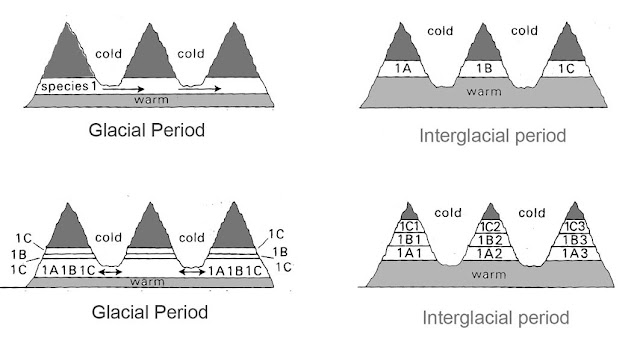
Warm pockets during cold times and a rediscovered species

For the last 6 million years or so, the Earth has been subjected to drastic temperature fluctuations. During the Pliocene, the Earth underwent cycles of warm wet and cooler dry periods. Substantial continental ice began to form in the Northern Hemisphere around 3 million years ago (Mya), before the planet was plunged into a series of ice ages. Although you may think of an "ice age" as a snowy period after which woolly mammoths and neanderthals disappeared, you may not know that currently we are simply enjoying a "summer" break from this ice age. The last 2 millions years of Earth's history has consisted of various glacial periods interspersed by warmer times, known as interglacial periods.

When animal and plant populations move up and out

Image
Plants are not always as static as they seem. While most individual plants stay relatively still compared to most animals (no, not all), plant populations can shift laterally over time in an analogous way to animal populations. The main difference is the rooted nature of plants means that they move slowly, across generations. The cause of this is usually environmental: the species is shifting as the climate changes or as competition or another form of pressure encroaches it. Richard Brusca and colleagues have published the results of a plant survey in Arizona which shows that species distributions have changed in the last 50 years. Since a survey carried out by Robert Whittaker in 1963, the vegetation on an area of the Catalina Mountains has crept its way higher up the mountain. Given the difference requirements and tolerance range of different plant species, the entire vegetation does not shift simultaneously or equally; this means that community composition has changed as some plan...