Posts

Cooking in Quito

Image
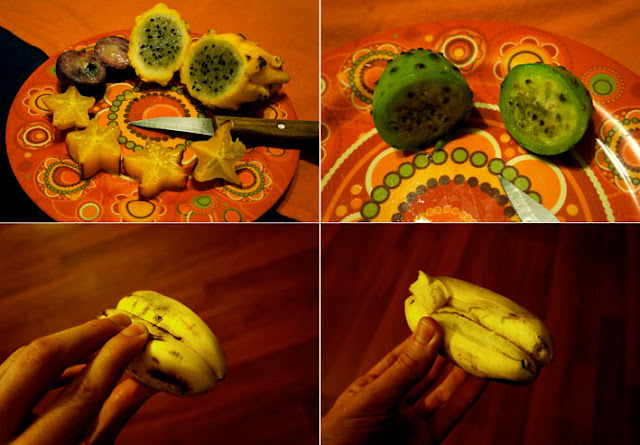
For the last few weeks I've been in Quito, stressing about my visa and fearing being banned from Ecuador. Quito is alright – as far as cities go, I suppose: it's got most services you could need, taxis are dirt cheap, and it does have some beautiful graffiti murals along many of the main avenues. But it's filthy and smelly; you need lungs of steel to breathe in the thick grey air and ideally a narrow frame or a pushy attitude to be in with a chance of fitting on the buses. It's not really the best place to be, especially while waiting to return to Payamino and the rainforest. However, one thing I can say I've been enjoying whilst here (as well as Gabe and Tamara's wonderful company, of course!), is the food. Eating out can be pretty cheap – if you know where to go and aren't vegetarian, as I am... –, but mostly we've been cooking ourselves and in some cases just experimenting with new (to us) ingredients. We've tried fruits of all shapes an...

Kingdom in the canopy (I): Biodiversity in Bromeliads

Image
During the University of Manchester's Tropical Biology field course in Payamino, Ecuador, I was studying the biodiversity within bromeliads. Not only is the arboreal cake that is the neotropical canopy layered with tiers of different plants, but many of these are inhabited by a variety of animals.  Bromeliads make particularly good environments for critters to colonise, as the spiralled, rosette arrangement of their leaves ( see Image 1 ) allows rainwater and debris to accumulate between the gaps. The equivalent of tiny ponds may appear, sufficient to act as nurseries for tadpoles; or soil may gather, enough to grow ferns and vines. A bromeliad is like a hanging garden basket – only better. Maybe a hanging zoological garden. Image 1 - Bromeliads in flower. Both the leaves and the flowers of bromeliads serve as homes for other life forms. The first two pictures, from the left, are taken in the Botanical Gardens in Quito. The right-most picture is taken in Payamino and is ...

Visas - the stuff of nightmares.

Image
Over the past week I've been up and down Ecuador on communications business - namely blitzing people and organisations with emails and conversing with the good people of the Universidad Estatal Amazónica. Currently, Tamara and Gabe (fellow volunteers / researchers at the Payamino research station) and myself are in Quito, the Ecuadorian capital, trying to extend our tourist visas. Much to our alarm, renewing your 90-day tourist visa is no longer an option, or at least not as straight forward as it ought to be to gringos like us. Given that "visa runs" to Peru and Colombia are no longer a guaranteed success, doing things officially in Quito seemed like the safest bet. After having been sent from Embassy to Ministry to Police, back to Ministry, to God-knows and back again, it's not looking particularly good. Now we're waiting to hear from the UEA about the matter – given the research station's new relationship with the UEA, visas for long-term volunteers ...

Spider cam.

Image
Picture from a camera trap set-up outside a tarantula burrow. This is its resident, Susana. © Xaali O'Reilly, 2012

Guess what left this print...

Image
© Xaali O'Reilly, 2012

Camera trap peek...

Image
August 2012 – This time round, got more than just biologists on the camera traps – below is a tayra ( Eira barbara ) and a lowland or spotted paca ( Cuniculus paca ). Tayra, Eira barbara.  © Xaali O'Reilly, 2012 Lowland paca,   Cuniculus paca.  © Xaali O'Reilly, 2012 September 2012 – From a third camera trap trial, agoutis and a squirrel: Agouti,  Dasyprocta punctata.  © Xaali O'Reilly, 2012 Agouti, Dasyprocta punctata.  © Xaali O'Reilly, 2012 Squirrel, Sciurus sp.   © Xaali O'Reilly, 2012

Kingdoms in the Canopy (II): Who's who up a tree

Image
The canopy of a tropical rainforest is a world very different from the ground it shadows. Trees are ladened with bromeliads and orchids, draped in mosses and ferns, tangled in vines and lianas, and, in some cases, burdened with the weight of other trees. In turn, the leaves of these plants growing on trees – known as epiphytic – may have other forms of plantlife growing on their leaves! These plants are epiphyllic . So, epiphytes grow on other plants (namely trees), and epiphylls decorate the leaves of other plants. Neither type of vegetation is parasitic. During the University of Manchester's Tropical Biology field course in Payamino, Ecuador, I was studying the biodiversity within bromeliads (more on here ). The first part of bromeliad collection is, obviously, finding them. I did just say the place is riddled with them. And it is. However, telling apart arboreal bromeliads and ferns, or even orchids, from the ground isn't always easy. Especially when looking up at a c...