Posts

When animal and plant populations move up and out
Image
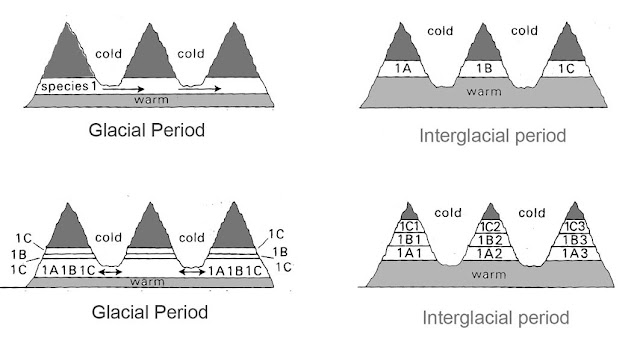
Plants are not always as static as they seem. While most individual plants stay relatively still compared to most animals (no, not all), plant populations can shift laterally over time in an analogous way to animal populations. The main difference is the rooted nature of plants means that they move slowly, across generations. The cause of this is usually environmental: the species is shifting as the climate changes or as competition or another form of pressure encroaches it. Richard Brusca and colleagues have published the results of a plant survey in Arizona which shows that species distributions have changed in the last 50 years. Since a survey carried out by Robert Whittaker in 1963, the vegetation on an area of the Catalina Mountains has crept its way higher up the mountain. Given the difference requirements and tolerance range of different plant species, the entire vegetation does not shift simultaneously or equally; this means that community composition has changed as some plan...

Is the Amazon still hurting over old extinctions?

Image
Mineral nutrients are essential components of any ecosystem. Their absolute presence and relative representation in an environment help shape habitats and the communities that can be supported on them. These nutrients can be one of the most important limiting factors to an ecosystem's productivity. The Amazon rainforest is one of the biologically richest environments on Earth. However, its soil is relatively poor, and much of the vegetation it supports lives on other plants (e.g. see previous posts  Who's who up a tree and Kingdom in the canopy ). One important limited nutrient in the Amazon Basin as a whole is phosphorous. Phosphorous (hereafter represented by its chemical symbol, P) is important for all living cells, with an active roll in energy transport and obtention in the form of ATP; as a core component of our DNA in the form of inorganic phosphate; and composing the living cell walls as phospholipids. Plants have the ability to take inorganic P from the soil and inc...

World Lion Day

Image
On April 27th I wrote a post (and baked a cake) for International Tapir Day – it seemed relevant to celebrate the buggers that were skilfully evading my camera traps. Nearly every day is a "World <insert animal here> Day". So, I'm not going to ramble about each of them, but it turns out that apparently today is the first World Lion Day , a campaign raising awareness for the king of the savannah. Lions, the rock stars of the feline world – just look at that hair! Okay, so maybe the glam rockers or '80s cats.

Twelve and a half months in Ecuador

Image
· 00:20 GMT-5, 2nd July 2012 -  Arrived in Ecuador's capital, Quito, when the airport was still smack bang in the middle of the city. · 18:55 GMT-5, 22nd July 2013 -  Watched the sparkling night lights that sprawl over Quito's mountainous façade shrink beneath the plane that took me from the equator. In an attempt to summarise the uncompressable and spare you my rambling, I've selected five photos from each of the months I spent in Ecuador on industrial placement. They're not necessarily the best photos nor personal favourites, but they all mean or represent something.

Camping out in the Amazon

Image
Earlier this week, I set out from the Amazonian research station where I am based with with two Kichwa guides, three hammocks, food for two days, and six camera traps. The intention was to place as many camera traps as possible within those two days. Image 1 -  The Churuyaku is born on the west side of Armadillo Hill, Payamino's tallest point, and snakes around until it ends up east of the mountains and near the village, where it spills out into Rio Payamino.

Monkeying about Armadillo

Image
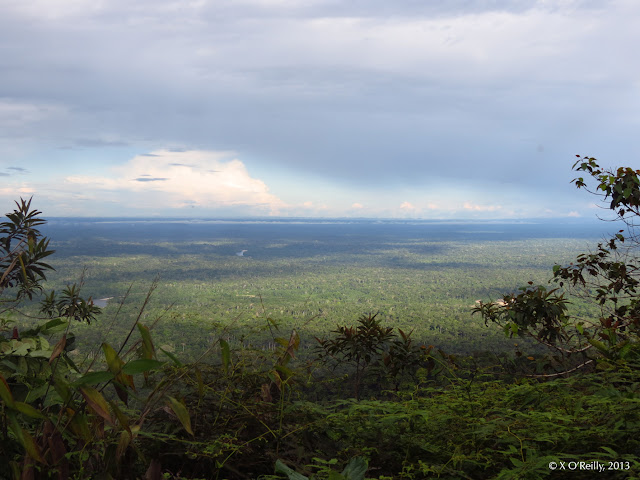
About seven weeks ago, I began the second part of my mammal diversity project, setting camera traps out in primary forest. The largest contiguous tract of primary forest in Payamino is probably that which surrounds and englobes Armadillo Hill, the highest part of Payamino. Armadillo Hill isn't actually that high (700 m at its tallest peak, so just 400 m higher than the research station), but the steep and hilly terrain of the surrounding area makes hiking challenging, especially once off the few trails and in the thick of virgin rainforest. Image 1 - View from the highest peak of Armadillo Hill, looking out onto the low(er)lands.

Bringing Dinosaurs Back To Life

I thought of apologising for my recent absence from the blogosphere – then I realised, I'm not certain anybody actually reads any posts that are not about camera traps or that do not display pretty pictures of birdies. Hopefully somebody does; if not, it is still writing practice for if I ever do produce something worth reading! Bringing an extinct animal back to life is never a simple task. Of course without implying it in the literal sense of "The Lost World", the biology of extinct animals can be reconstructed on hypotheses and theories – even if often one tries to exclude another or they change over time as more evidence comes to light. How extinct animals lived inspires the same fascination as how living species do, with the added charm of mystery and plenty of space for imagination. Dinosaurs are a clear and classic manifestation of the desire to investigate the biology of extinct animals. Here I want to give a (relatively?) brief overview of some of the m...