Posts

Showing posts with the label ecuador

Water Worlds

Image
This post was originally published under the title  "Water Worlds"  in the December 2016 issue of  The Biologist , the Royal Society of Biology's magazine. If you're a member of the RSB you can also view the  article on their website here . Tropical rainforests are known for being full of life. Whether you're captivated by the calls of colourful birds, mesmerised by hypnotically patterned cats, or fascinated by the apparently infinite variety of invertebrate life, you still have to acknowledge that what makes a rainforest are the plants. A forest is by definition a collection of trees, but there is a whole lot more to plant life in a rainforest. Coating every surface, including the trees themselves, are more plants. Some of these we would as surface-covering vegetation in temperate environments as well, like the mosses and liverworts that coat stone walls or the dandelions that poke their sunny faces out between cracks in the concrete. However, there are ...

Happy World Turtle Day! 2014

Image
To celebrate World Turtle Day (and here I'm using the word turtle broadly to mean all Testudines/Chelonia), here are some photos of sea turtles I took while snorkelling around León Dormido and Giant Galápagos tortoises on Santa Cruz, both in the Galápagos Islands. Plus a drawing that I don't appear to ever have finished... Drawing turtle wrinkles is really boring. © X O'Reilly

No significant difference.

Image
Often in science, researchers fear their results will not be statistically significant. People are afraid of 'negative' answers. I've always found this rather bizarre, because an answer is an answer, be it yes or no. Especially in science, a negative answer is just as important as an affirmative one – it's not the same as if the question hadn't been investigated in the first place. Anyway, to stop myself before I ramble any further (before I am tempted to write an essay on great answers born from non-significant results)... I was actually glad to find that the results from my research in Payamino over the past year did not yield any statistically significant differences. Analyses of my field work data did not reveal any significant differences in mammal diversity between primary and secondary rainforest samples. I shall post about the results and conclusions at greater length some time, but for now I will just say what the results of this relatively small-scale st...

Twelve and a half months in Ecuador

Image
· 00:20 GMT-5, 2nd July 2012 -  Arrived in Ecuador's capital, Quito, when the airport was still smack bang in the middle of the city. · 18:55 GMT-5, 22nd July 2013 -  Watched the sparkling night lights that sprawl over Quito's mountainous façade shrink beneath the plane that took me from the equator. In an attempt to summarise the uncompressable and spare you my rambling, I've selected five photos from each of the months I spent in Ecuador on industrial placement. They're not necessarily the best photos nor personal favourites, but they all mean or represent something.

Camping out in the Amazon

Image
Earlier this week, I set out from the Amazonian research station where I am based with with two Kichwa guides, three hammocks, food for two days, and six camera traps. The intention was to place as many camera traps as possible within those two days. Image 1 -  The Churuyaku is born on the west side of Armadillo Hill, Payamino's tallest point, and snakes around until it ends up east of the mountains and near the village, where it spills out into Rio Payamino.

Monkeying about Armadillo

Image
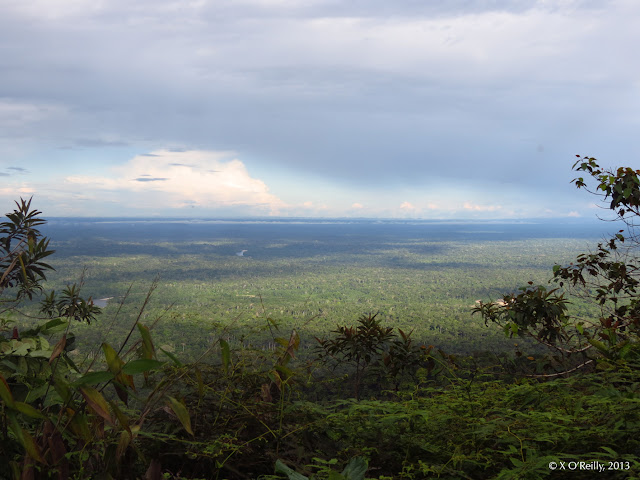
About seven weeks ago, I began the second part of my mammal diversity project, setting camera traps out in primary forest. The largest contiguous tract of primary forest in Payamino is probably that which surrounds and englobes Armadillo Hill, the highest part of Payamino. Armadillo Hill isn't actually that high (700 m at its tallest peak, so just 400 m higher than the research station), but the steep and hilly terrain of the surrounding area makes hiking challenging, especially once off the few trails and in the thick of virgin rainforest. Image 1 - View from the highest peak of Armadillo Hill, looking out onto the low(er)lands.

Happy World Tapir Day!

Image
Image 1.1 - Tapir-themed jungle cake The 27th of July is world tapir day. Last year I became aware of this event through a tapir-obsessed friend of mine, Michael Natt (who's birthday it also happens to be – hippy barfday !). Now that I am living in a place tapirs are native to, I thought it would be appropriate to celebrate this day here at the Timburi Cocha research station with a tapir-themed jungle cake ( Image 1.1 ) and to dedicate these bizarre mammals a blogpost. Image 1.2 - Quick world tapir card to celebrate the occasion. © X O'Reilly

Devastated Garden

Image

Recession... In Timburi Cocha

Image
I made the collage bellow in November when things weren't so good here in Timburi. The research station was suffering some funding issues, and all the consequences that entails. We're fine now, but for a while things were pretty tight. However, I will admit that some of the statements in the collage are a wee bit exaggerated – but you get the picture!

Camtrapping: The jaguar and the anteater

Image
When you are doing a camera trap project in the Neotropical rainforest, a part of you expects to get all sorts of exotic wildlife, like big cats and fancy herbivores. Really, what you more often end up with, is a lot of rodents and the same deer species, with some birds and the occasional carnivore. After a while camera trapping in pre-determined random places (science, go figure), you still pray that you'll get something large, new, and exciting, but at the same time have resigned to expecting the same species over and over, hoping that you'll at least catch an agouti with a funny pose or a brocket deer pulling a face. Nonetheless, it's always great to look through the latest catch my camtraps have to offer. The locals who work with me (and whoever they may have been talking to about the camera traps) are equally fascinated to see the pictures, even if the animals are more familiar to them than to I. I realise that this is usually because they realise where they can no...

El momento más terrorífico de mi vida (y mi primer blog en español)

La semana pasada, tuve la experiencia más terrorífica que puedo recordar. Quizá leyendo esto parecerá que simplemente no he tenido ninguna ocasión incómoda en mi vida; si es así, si parece que nomás me hago la quejicas, es porqué mi vocabulario no alcanza hacerle justicia a la instancia. Bueno, tampoco es cuestión de darle una introducción que tampoco se merece, por no acabar con un anticlímax.

Birds of Ecuador

Image
As I mentioned in a previous post , I've never been that big on birds – except penguins, but subconsciously I think my brain does not want to acknowledge them as birds. I'm not sure why, especially given my obsession with dinosaurs, the only living representatives of which are the Aves of today. In my second year of Zoology at the University of Manchester, I became extremely interested in bird physiology, especially their respiratory physiology, and the evolution of avian flight. And I've occasionally painted birds : they're pretty and they sell well. Only recently (now that I live in an avian hotspot) have I started really started to appreciate their diversity and make a genuine effort to understand their taxonomy. Here in the Ecuadorian Amazon I have been conducting a camera trap studies on mammals for several months now, and am considering switching the theme to medium-to-large terrestrial vertebrates, on account of the amount of bird species and individuals s...

Things one sees whilst camera trapping (forgive the lack of photos...)

When putting out camera traps, I carry a backpack full of photographic equipment, yet I don't usually bring my good camera with me, because often my guide and I cross water on foot or end up floating down Payamino River for 3 km. Unusually, yesterday I had a motorised canoe at my disposal, because I was filling the points of my camtrap grid furthest from camp, and it would have taken me more than one very gruelling day to get them out otherwise. The motorised canoes are wide and strong, and through most things still get wet in them, I'd be comfortable to carry my camera in a dry bag in these boats, as there'd be no need for my camera to be submerged. Unfortunately, I wasn't expecting my guide to turn up until today and so got ready in a fluster yesterday, forgetting my camera.

Camtrap update - March 2013

Image
Figure 1 - Camtrap grid design When people ask what kind of research I am carrying out in Ecuador , there's a part of me that worries my project will sound lazy. Camera trapping – leaving cameras out for 21 days, picking them up, downloading pretty pictures of animals, and putting the cameras back out again. The truth is, it's as tough as any project. Usually I position 2 or 3 cameras at a time until all six the station possesses are out. The maximum distance between each consecutive camera is 1.4 km (if measuring the distance between two cameras placed diagonally in relation to one another on the grid) or 1 km if in the same row or column ( figure 1 ). This does not sound like much – so why position so few cameras at a time? Walking 1 km on a path does not take much time at all; walking 1 km down a forest trail (especially if you're used to the relief of the jungle floor and don't get stuck in mud) shouldn't take much longer. But walking 1 km through unc...

Kingdoms in the Canopy (III): Climbing Trees

Image
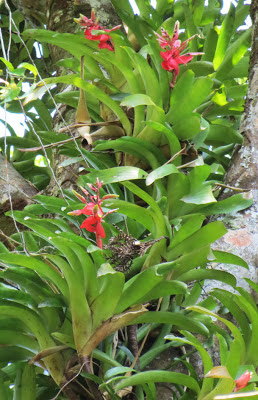
By now you may have noticed I have a growing obsession with my summer study subjects, epiphytic bromeliads. Those hanging zoological gardens that adorn the trunks and branches of neotropical trees ( Figure 1 ). Figure 1 - Flowering bromeliads I've already mentioned how I collect them   – by climbing trees and cutting the bromeliads down. What I haven't really explained it how I climb trees. Last March, I completed the Basic Canopy Access Proficiency course, offered by Canopy Access Limited . The course teaches you to use double rope canopy access techniques to pull yourself up into the trees, as well as tying knots, differentiating between good and bad trees to climb, and everything to do with staying safe whilst suspended in mid-air from ropes over a branch. First things first, choosing your tree. This is important, not only must it suit the purposes behind your climb (in my case: are there bromeliads? ), there needs to be a suitable anchor branch to hold your ...

The Jungle [Cook]Book - 2

Image
In an earlier post  I mentioned how despite living in the middle of the rainforest without an oven, at Timburi Cocha we've been enjoying little homemade luxuries such as breads and cakes. It is no rocket science, simply a method of using pots and pans as mini-ovens on a gas stove. But let's just call it jungle baking, because everything sounds better with the word "jungle" in front of it. I've decided to describe how we make jungle cake, because it is something that always seems to surprise visitors and people I speak to back home.

ALIEN – Fish-style...

Image
As a young child in Spain, one of the main break time games in school was an organic version of marbles. Instead of the colourful glass balls, we used to flick " bicho bolas "around the ground and at each other. These bicho bolas are known in English as pill bugs, roly-polys, or woodlouse, and a biologist might recognise them as a type of terrestrial isopod. Isopods are a large group of crustaceans. They don't all roll up into "pills", nor is the whole group terrestrial. Indeed, not all are even free-living, with various species and families parasitising both vertebrates and other invertebrates. Not all parasitic isopods are obligate parasites for their whole life and, like most parasitic animals, generally each type of isopod specialises in abusing a particular host. There are entire taxa of isopods which parasitise a specific taxa of animal, with each species bound to another species. Cymothoidae is a family of fish parasites. Some of these are ectop...

Camtrap update: Tigrillo

Image
From the lastest camera trap placement comes this little guy... Leopardus pardalis  captured by a camera trap placed in Payamino secondary rainforest, Ecuadorian Amazon. © Xaali O'Reilly

Merry Christmas!

Image
Happy Christmas to everyone, christian or not. Remember that the celebrated birthday of Jesus "happened" to coincide with many other festivals. I am atheist, but still enjoy the holiday! Iberian lynx composition by X O'Reilly, 2010. Original lynx photo © Lynx Ex-Situ .

I know no birds

Image
Admittedly, I am very bad at birds. Their beauty and diversity fascinates me, though I am far more interested in their respiratory physiology and the fact their dinosaurian ancestors. However, I now think we know most of these guys, thanks to the help of fellow zoologist Terry Garner, who pointed me in the right direction for most of them, and University of Glasgow MSc student Carly Aulicky for confirming their identity – cheers guys! Image 1 - N octurnal curassow,  Nothocrax urumutum . © X O'Reilly